
Is it working yet?
By Liz Kovarsky
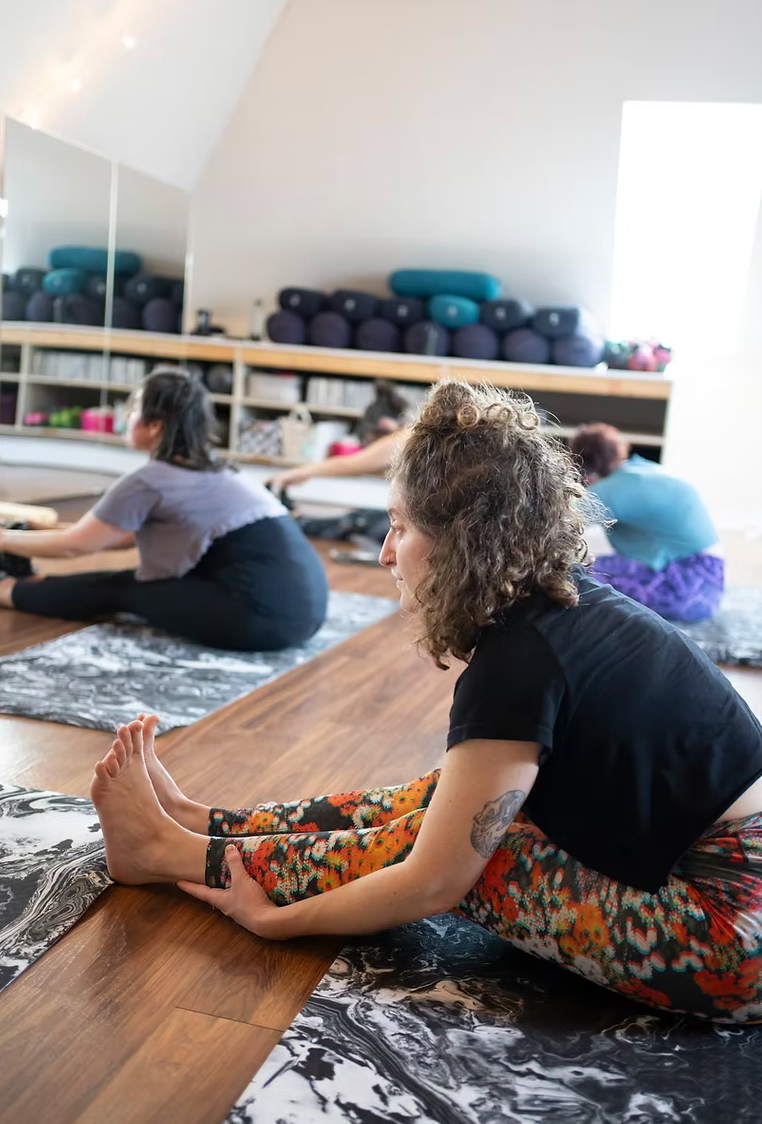
Connecting pleasure to the work I’m doing at Electric Cottage Collective feels especially important right now. Here’s why. I signed a lease at 82 Pleasant Street in September 2024. Then I panicked. Did I just do something incredibly financially irresponsible? My sleep became spotty. My body started having strange symptoms. I would fall asleep and wake up thinking the same thing: How will I make this experiment work? My vision for ECC was a coworking, arts, and wellness community space in Brunswick, Maine centered around accessibility, creativity, collective care, and connection. We started renovating the space and, slowly, it began to resemble what I had imagined. I shared the project online and found our first studio-office renter, who began using the space not only for their own creative work and day job, but also for imagining community-led projects. And still, I kept asking myself: Is it working yet? What is the yardstick for success when running an anti-capitalist business? Is success simply getting someone else to understand the vision well enough to participate in it? I’ve been trying to untangle capitalism from commerce, money from worth, storytelling from marketing — and it’s been a roller coaster. We opened for public classes in January. Attendance was small at first, but it felt exciting to teach in a space intentionally designed around accessible wellness classes, coworking, creative programming, and community care. A few coworking members joined. I had started this project partly in response to our political climate and the absence of safe(r), community-rooted gathering spaces for people living on the margins and for grassroots organizing in this region. Then the 2025 election happened. Fear, isolation, and exhaustion intensified for many people in our community, and spaces like this suddenly felt even more necessary. Again: Is it working yet? Do I define success by my own fulfillment in teaching and making art? By increasing accessibility through sliding-scale pricing and scholarships? By creating a space where people outside the dominant culture feel safer, welcomed, and valued? Gradually, the space filled out. Two studio renters. Three studio renters. More coworkers. Daily classes. People started hearing about us. Friendships began forming outside ECC. We hosted our first major dance party fundraiser and raised money for a local organization we care about. Maybe success looks like people gathering for connection, creativity, and community support. But while all of this was happening externally, internally my nervous system was winding tighter and tighter. I started therapy. It has never been particularly reasonable to work a full-time job while simultaneously building a business that is itself another full-time job. My body could not unwind. My anxiety intensified. There was joy and pleasure in dancing with people, teaching yoga, making art, and watching community slowly form — but I barely had time to care for myself beyond survival. Yes, I could pay my bills — but could I cook myself a meal? Sleep enough? Sustain my relationships? Feel present in my own life? Not really. The contradiction became impossible to ignore: I was building a space centered around collective wellbeing while privately struggling to access rest myself. And yet, moments kept cutting through the exhaustion. One day after yoga class, I overheard someone say, “I didn’t have community in Brunswick before coming here.” For people who are rarely centered by dominant culture — women, queer people, disabled people, artists, people of the global majority, caregivers, neurodivergent people, people with mental health struggles, grieving people, sex workers, people living below the poverty line, and people who have never fully felt like they belonged anywhere — having a place where they can feel welcomed, connected, and human together: That is success to me. A few weeks later, another member told me, “I’ve found this class really powerful and helpful. I even made a new friend — the first friend I’ve made in Brunswick.” That is success. Our very first studio renter went on to create a local mutual aid zine whose first organizing meetings happened inside ECC. That is success. People regularly tell us, “I don’t usually like group movement classes, but the teachers here offer variations for every level, so I feel like I can actually participate- and they’re fun.” That is success. What I’m increasingly realizing is that so much of this work is actually about pleasure. Not pleasure in the commodified sense we’re constantly sold — not luxury, escapism, or optimization disguised as self-care — but pleasure in the deeper Audre Lorde sense. In “Uses of the Erotic,” she describes the erotic as a source of power rooted in feeling fully alive, connected, expressive, and present within ourselves and with each other. She writes about it as a force that helps us recognize what truly satisfies us rather than what we’ve merely been conditioned to tolerate. That framework has become connected to how I think about ECC. Because what we’re building here is not simply a coworking space or wellness studio. It’s an attempt to create conditions where people can reconnect with themselves, with creativity, with rest, with embodiment, and with each other — all the things capitalism systematically asks us to suppress in order to remain productive. Pleasure, creativity, rest, movement, friendship, slowness, and collective care are not distractions from meaningful work. They are meaningful work. I think that’s part of why ECC resonates with people. So many of us are starving for spaces where we do not have to perform hyper-productivity or pretend that we fit in to deserve belonging — spaces where we can exist authentically. There’s a strange mix of freedom and fear that comes with quitting your full-time job to pursue something you believe in, which is what I’m doing starting June 1st. For almost two years, I balanced multiple identities simultaneously: social worker, art teacher, yoga and dance teacher, community organizer, trainer, program coordinator, freelancer, and founder. ECC was built in the margins of my life — in early mornings, late nights, weekends, and every spare hour between trying to survive and trying to imagine something different. Now, for the first time, I’m stepping away from the stability of traditional employment to focus entirely on ECC. Honestly, it feels like a leap of faith- both terrifying and exciting. This is the next phase of the experiment. I still don’t know whether community-centered work can sustainably support me financially in a culture that rewards overwork and burnout. I don’t know what happens when the safety net disappears and the thing you love becomes responsible for keeping you afloat. I do know that working for nonprofits hasn’t been it for me, for now. I do know that ECC has already become proof that people are hungry for another way of being. Electric Cottage Collective was born from the conviction that work should not cost us our wellbeing. After years of supporting communities impacted by interpersonal and systemic trauma, I realized burnout is not only personal — it’s cultural. We’ve normalized exhaustion, isolation, and disconnection as unavoidable realities instead of warning signs. ECC became my response to that reality: a regenerative sanctuary in Brunswick, Maine where creativity, rest, work, pleasure, and community are all allowed to coexist. What happened during our first year exceeded anything I imagined possible. People come here for coworking or a class, but they stay for the relationships. For conversations between classes. Collaborations sparked over tea. Dance parties that turn strangers into friends. The relief of entering a space where nobody expects you to be any kind of way. So many people who fill this space are the people quietly holding everyone else together: social workers, therapists, parents, nonprofit workers, teachers, artists, healers, caregivers, nurses, organizers, and cultural workers. People whose labor revolves around care, but who rarely receive spaces that care for them in return. In our first year, ECC hosted 646 arts and wellness classes and welcomed 691 students through our doors. We raised money for mutual aid and local nonprofits, built scholarship funds to keep classes accessible, and created programming that includes yoga, dance, sound healing, craft clubs, figure drawing nights, workshops, clothing swaps, dance parties, retreats, and teacher trainings. But none of this exists because of me alone. ECC has been built collectively by people who believed in this vision before there was any proof it would work. People painted walls, moved furniture, offered work exchanges, cleaned studios, donated art and supplies, shared posts, brought food, stayed late after events, and continually showed up with generosity and trust. Our teachers and facilitators make this place feel alive in ways I never could on my own. ECC has shown me that business can look different. It can prioritize relationships over rapid growth. Accessibility over exclusivity. Collective care over hustle culture. It can be imperfect and evolving — like all of us — and still be successful. And still, choosing to fully devote myself to this work feels both terrifying and exciting. There’s vulnerability in believing in something so deeply that you’re willing to risk stability for it — especially when what you’re building does not fit neatly into capitalism’s preferred success stories. There is no guaranteed roadmap for businesses rooted in reciprocity instead of extraction. But there is also something profoundly freeing about finally allowing myself to try. Going full-time with ECC means trusting that what we’re building matters. It means no longer splitting my energy between survival and purpose, and instead seeing what becomes possible when my full attention goes toward this weird, beautiful ecosystem we’ve created together. More than anything, it means I get to deepen the work. I get to expand programming, support facilitators more intentionally, strengthen partnerships, increase scholarship offerings, and continue cultivating a space where people can gather without needing to earn belonging or value through productivity. I want ECC to remain proof that another model of business is possible — one rooted not in endless expansion, but in reciprocity, accessibility, creativity, pleasure, and care. I still don’t know exactly what the future holds. But ECC exists because people keep choosing to participate in this experiment together.
And now, instead of asking whether this experiment is working, I’m trying to recognize that it already is. Maybe part of redefining success means learning to see it while it’s happening. |


Comments