
Yoga is not a performance
By Liz Kovarsky
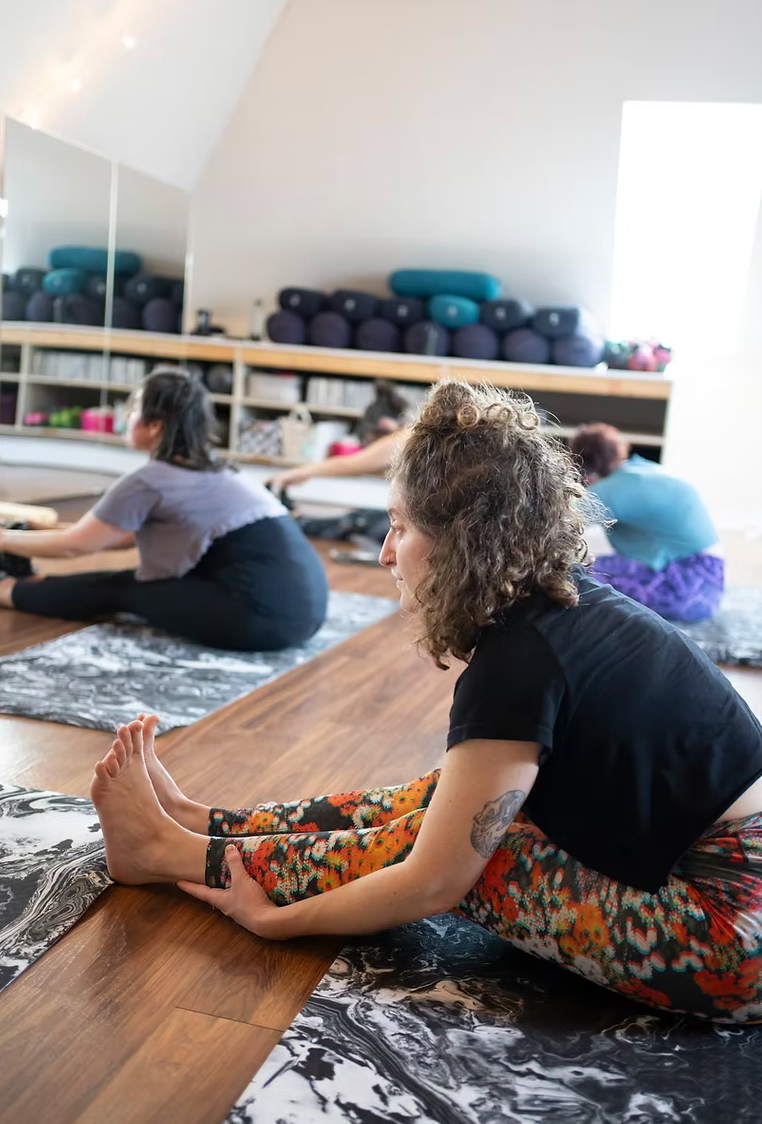
Yoga is not something you perform. At Electric Cottage Collective, yoga isn’t a performance, a fitness trend, or a mood you can curate. It’s a way of returning to the body in a culture that constantly rewards leaving it. What we practice, teach, and gather around is less about “doing yoga” and more about noticing what becomes possible when you stop trying to optimize your experience of being alive. So when we talk about restorative yoga, yin yoga, queer yoga, yoga for grief, yoga for pregnancy and loss support—and even what we don’t include—we’re not describing separate categories. We’re tracing different expressions of the same question: what does it mean to stay in a body without abandoning it? Restorative yoga begins that inquiry by removing demand. The body is fully supported so it can stop bracing. There is no goal, no intensity to achieve, no shape to improve. It’s a practice of unlearning urgency—allowing the nervous system to downshift into safety without requiring exhaustion as proof of worthiness. Yin yoga moves differently, but lives in the same ecosystem. Where restorative asks you to be held, yin asks you to stay. Shapes are held longer, not to achieve flexibility, but to build relationship with sensation itself. It’s less about release and more about witnessing what arises when you don’t immediately exit yourself. Queer yoga, in this context, isn’t a style layered on top—it’s a refusal of the idea that yoga has ever been neutral. It asks who gets to belong without performing ease or correctness. Bodies aren’t corrected into acceptability; they are witnessed as they are. That shift changes the practice at its core. Grief makes that even more immediate. Yoga for grief isn’t about resolution. It creates conditions where nothing has to be fixed. Grief moves through the body in ways language can’t organize, and these practices offer space for that—without pressure to make it useful or meaningful. The same is true in yoga for pregnancy and child loss, where the body is carrying experiences that are both deeply physical and often unnameable. The practice isn’t about returning to a previous self, but learning how to remain in a body that has changed and still deserves care. This is also why much of contemporary yoga culture doesn’t quite land here. When yoga becomes speed, choreography, or output, it can start to mirror the same productivity logic it claims to interrupt. When it becomes novelty or branding, attention shifts away from relationship and into consumption. Even “the vibe” can become a kind of shortcut. Soft lighting, playlists, beautiful spaces—none of these guarantee safety or presence. A room can look calm and still feel overwhelming. A class can feel aesthetic and still be disconnected. Bodies don’t respond to branding; they respond to context, pacing, history, and relational safety. Accessibility is part of that context too. All of our yoga classes are offered on a sliding scale, as a small way of loosening the idea that care, rest, and embodiment should only be available at a fixed price point. The idea behind our workshop, “The Vibe Is A Lie” comes out of that tension. Not as a correction, but as a question: what happens when we stop treating “vibe” as shorthand for safety or truth? What do we notice when we get more curious about how a space actually feels in the body, rather than how it looks or is described? It’s less of a workshop in the traditional sense, and more of a shared inquiry. A place to slow down enough to notice the difference between what’s curated and what’s real. To pay attention to how safety forms—not through aesthetics, but through consent, pacing, and the body’s own signals. Yoga is not something you perform. It also sits within a larger question about the culture of yoga spaces in the West. When yoga is shaped primarily by aesthetics, branding, and consumption, it can drift far from the lineages it comes from. This work is one small part of moving differently—not by claiming purity or authority, but by practicing more attention, care, and accountability to what yoga asks of us beyond how it appears. Instead of trying to manufacture a certain mood, this is a space to notice what actually helps your body feel safe or settled—things like choice, pacing, how you’re being guided, and what your body is communicating. It helps you tell the difference between what genuinely supports you and what just looks or feels good on the surface. That attention is the practice. Because all of this—restorative, yin, queer yoga, grief yoga, “The Vibe is a Lie”, pregnancy and loss support—is moving in the same direction: away from performance, away from urgency, away from the idea that the body has something to prove. Toward something quieter, and more honest: Stay. Notice. Allow. Return. Because underneath all of it, the same truth keeps surfacing— Yoga is not something you perform. It’s what happens when you stop leaving yourself. |


Comments