
should I teach yoga?

I trained in heated power yoga in 2011 at Prana Power Yoga in Boston. I went on to teach in that style for about four years, until doubts and questions began to surface.
Why does a practice that is deeply internal, transformational, spiritual, and collectivist have such an unspoken focus on the external? Up to that point, I had rarely encountered teachers who didn’t wear Lululemon, weren’t thin, white, able-bodied, or native English speakers. I also rarely heard honest conversations about how difficult it is to make a living teaching yoga. Instead, there were promotions for “money mindset” workshops, “financial wellness gurus,” $5,000 retreats to Bali or Thailand, and expensive coaching services—often offered by people whose only formal training was in yoga itself.
These questions sent me on a journey. I felt compelled to continue sharing a practice that had deeply transformed me, yet I felt profoundly misaligned with the Western yoga industry. I began teaching donation-based classes, where I met more diverse teachers and students. Those relationships changed both me and my teaching.
I could no longer, in good conscience, treat yoga as fitness or charge $20 per class. At the very least, this practice needs to be financially accessible.
Eventually, I began teaching trauma-informed yoga with Sea Change Yoga in Portland. There, I joined a community of teachers who were asking similar questions. I taught people in recovery from drug addiction and people who were unhoused. Suddenly, yoga had nothing to do with what we were wearing, whether poses looked “right,” or the next training or retreat. It was about sharing the real skills yoga offers: connection to our own bodies, to each other, and to the collective.
After about five years of teaching trauma-informed yoga, I felt I had more to learn and more to give, so I went to graduate school for social work. I loved the learning and was struck by the clear parallels between yoga and social work—the Yamas of yoga align closely with the social work code of ethics. I continued teaching yoga throughout grad school, and it became an essential embodiment practice while stepping into environments that can easily overwhelm new social workers without adequate support. A strong yoga practice provides internal, embodied resourcing that is irreplaceable.
Then 2020 happened.
George Floyd was murdered. The Black Lives Matter movement became a central focus, and once again I asked myself: Should I teach yoga? Should white people teach yoga? I stopped teaching for a couple of years.
Yoga originates in India and Africa. It is 2,000–3,000 years old and has a long history of resisting colonization. Who was I—a white, upper-middle-class, cisgender, American, Eastern European Jew—to take this practice out of its cultural context and benefit from it? I felt ashamed for not grappling with this sooner. It felt deeply appropriative to extract an ancient, spiritual, collectivist practice and serve it back primarily to people who look like me, while those from the cultures yoga comes from are often excluded from or uninterested in Western wellness spaces.
Eventually, I began to wonder: Was I avoiding this because it was complicated? Was I unwilling—or unable—to hold the nuance required to engage more fully? Was I being lazy or unimaginative by thinking, If I can’t teach yoga the way it’s usually taught, then I can’t teach at all?
I realized how harshly I was judging myself.
I could still bring this practice to my community—it just couldn’t look the same. I began offering a class called Yoga for Connection. We practiced some asana, then journaled about a topic related to yoga philosophy or history, followed by a short group conversation. This felt more connective, more aligned with honoring the whole of yoga—all eight limbs—rather than just the external, physical practice that dominates mainstream media. Then I took the word yoga out of it completely, but that didn’t feel right either.
Over time, this way of teaching continued to evolve. Most recently, I’ve begun integrating my own lineage. I’m not religious, but I come from a Jewish ethnic tradition that emphasizes justice, community care, and perseverance. One teaching from Pirkei Avot that guides me is:
“It is not your duty to finish the work, but neither are you free to abandon it.”
We can’t do everything, but we can each do our part.
This practice is an opportunity to tend to ourselves as we tend to others—remembering that rest and healing are not luxuries, but essential acts of justice.
As a trauma-informed yoga teacher, artist, and social worker, my approach centers accessibility, autonomy, and choice. With over a decade of experience teaching public and trauma-informed yoga and dance, I understand trauma as a loss of power—especially the power to choose and to feel safe in our own bodies.
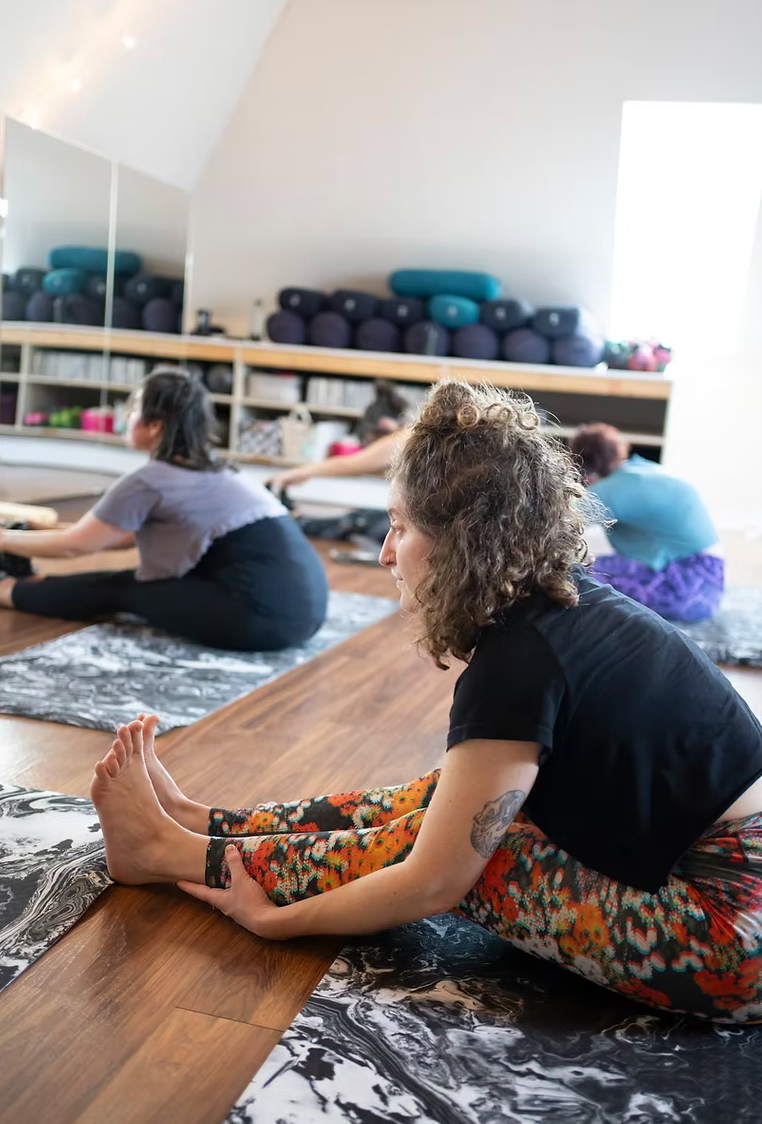
This practice is less about achieving perfect poses and more about cultivating connection, presence, curiosity, and compassion. Through gentle movement, stillness and breath, we explore how to reconnect with our bodies and what it means to be part of a larger ecosystem of care.
This practice is for all bodies, all experiences, and all levels.
I can’t tell you whether you should teach yoga.
But I can tell you that I do—just a bit differently than I used to.


Comments